Episode Transcript
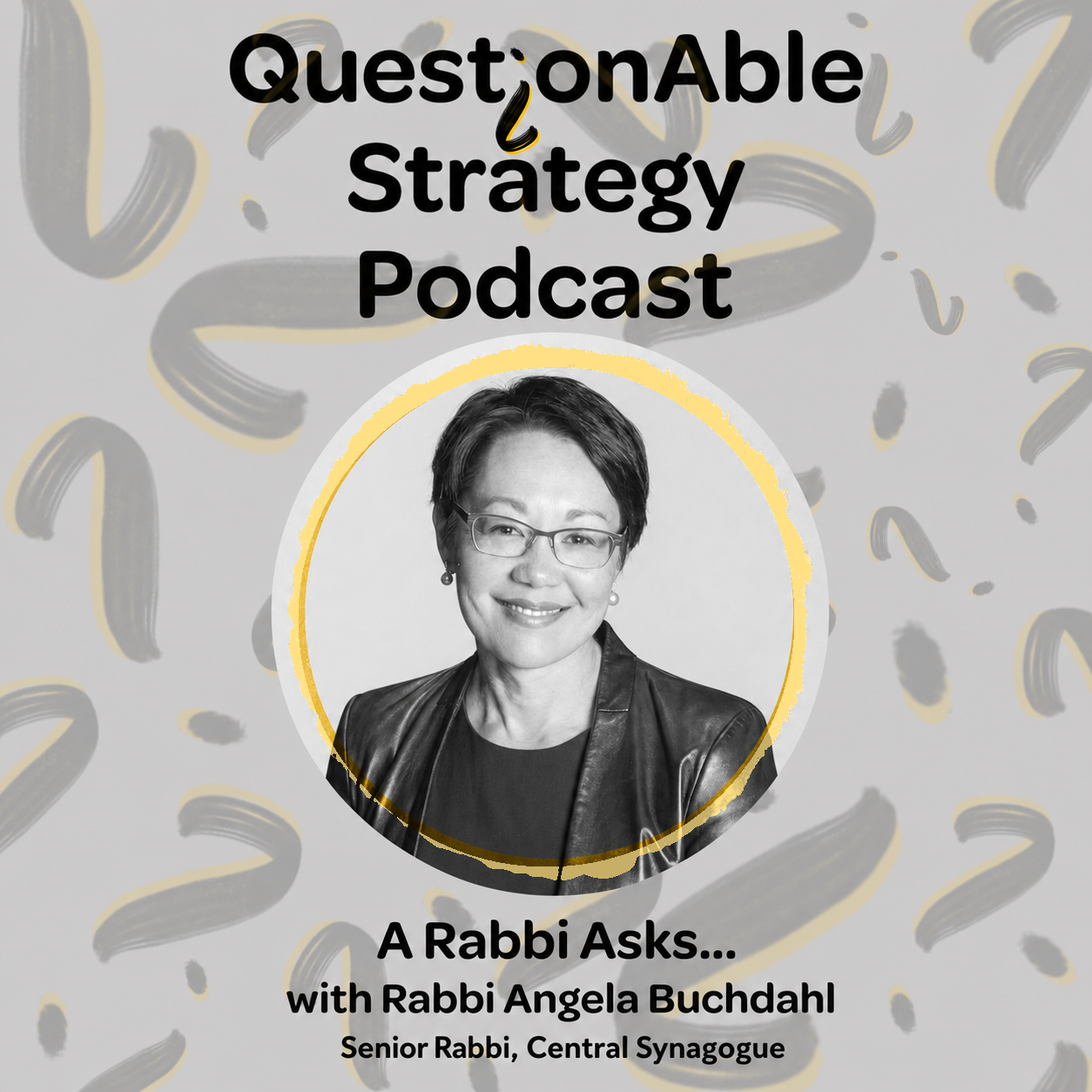
I guess part of what I have understood having a Buddhist mother, a Jewish father, and Christian imos or aunties, is that I think that at the core, every religious tradition is actually trying to answer the same questions about why we're here, how we deal with suffering, how we lift up those who are the most marginalized and vulnerable, and how we are our best selves. The voice you just heard was Rabbi Angela Buchdahl. And let me tell you, today's episode is incredibly special to me. Back when I first started this podcast, I had a list of dream guests. I was asked about this many times by basically everybody that I ever talked to about doing this podcast And at the top of my dream guest list was Rabbi Angela. She was incredibly kind to talk to me right when this was just a germ of an idea and encouraged me to go all the way with it and really explore what QuestionAble Strategy had to offer. Ever since I was 13, I had been going to bar and bat mitzvah ceremonies in New York City at Central Synagogue, and I was always completely awestruck and inspired by seeing Rabbi Angela up there leading services, singing her heart out. She broke the mold of what I understood Jewish leaders to be, and she inspired me and continues to inspire me as an Asian American woman to really see myself in all sorts of rooms. She is the first East Asian person to be ordained as a rabbi in North America, and for the past 12 years, she has been the senior rabbi at Central Synagogue in New York City. She's also the first woman to ever lead Central Synagogue, which is a really big deal. She recently published a New York Times bestseller. Not a shock to me whatsoever. It's called Heart of a Stranger. It's such a great book. I recommend everybody buy it and read it. It'll definitely teach you, first of all, that you're not alone when you're feeling on the outside. But also it really leans into identity and self-reflection, reaching your hand across the aisle and understanding how other people think, not just you. And I'm really proud to have had this conversation with her where we can explore those topics. We drill into religion. We drill into belief in God. We talk about grief. We talk about what it's like to be mixed race, Something that I deeply resonate with for obvious reasons. And I couldn't feel luckier to have had a, a better guest for QuestionAble Strategy who really embodies all of the traits, lessons, and principles that we really dig into here at this podcast. So I'll get out of the way. This is How a Rabbi Asks Questions with Rabbi Angela Buchdahl. Rabbi Angela, thank you so much for coming on QuestionAble Strategy. It's so nice to talk to you today Thank you. It's so good to be with you again, Antonia I'm gonna kick this off with the first question that I ask everybody, which is who inspired you to be curious? You know, I feel like, every child is born deeply curious, so it's more that, nobody in my life embarrassed me out of it. I really think that all kids are born this way, where you just wanna know how things work. I mean, isn't every two-year-old's main question why? Why? Why? But what ends up happening is along the way, people shut us down or say, "Stop asking so many questions," or maybe worse, saying, like, "That's a stupid question." And I guess I was just lucky that I was in a house where there was infinite patience for my questions, especially from my father, and a kind of celebration of the questions from both of my parents. And so I think that there was a way that it's not so much that someone had to inspire me to be curious as much as, no one, squashed that innate curiosity that I think we are all born with. I think that that's so true, and a very common thread that I've seen throughout the folks that I've spoken to, which is I was an extremely curious child, which sure, I do agree that all children are born innately like that, but they're definitely encouraged to pursue that curiosity, and I think that's really important. For anybody listening who's raising kids, Mhm. make sure that you encourage that curiosity. So you were born in Korea and you moved over to the US when you were really young. I am wondering, how did crossing cultures that early in life shape the way you learned to be curious or shape the way that you've maintained that curiosity? Oh, that's a great question because you're making me think about the fact that there are so many things that when you're a child, you just take for granted as like, this is how things are because you don't know any other model. And for many people, it's not until you maybe leave your home maybe for the first time to go to camp or maybe to go to college where you actually think, "Oh, there's a whole different way of doing this," or, "This can look very different." I think because I was born in Korea, I had a different first language. I lived in a home that was multi-generational with my grandmother and with my aunts and uncles and cousins all within like a, a block radius. that's just what life was. But then when I moved to America at age five, suddenly the contrast of the culture, the language, the foods, it, it just sort of sparks this sense that like you notice what's different. And so I think from a very young age, I had a foil to my experience that oftentimes people don't get until they're much older or finally leave the nest. And then to also be in the Jewish community 'cause I was raised, in the Jewish community of Tacoma, Washington, where I grew up from age five, in a very Christian society also created a lot of curiosity. So I wanted to know about what is other religions, you know, what do they say? But also people became very curious about and that actually, creates an environment in which there's a kind of openness to seeing difference. and I really was blessed, to grow up in a family in which diversity was celebrated and seen as something, that invites more learning and more joy. So, you know, my mom would say, you can take the best of all the worlds you're a part of, Angela." and so that was sort of the invitation. So it actually did make me question a lot of things because I just didn't take for granted that like, oh, of course these are the holidays I celebrate when so many people celebrate differently. Or of course, this is the way we eat our meals together when people ate very differently in different cultures. And I just noticed those differences early on. I love that illustration because as somebody who's also half Asian, I feel like I got that ability when I was young too. And not only am I half Chinese, but I also lived in China when I was young. I moved there when I was nine, lived there until I was 10, and so I also got that kind of foil to my everyday life in New York City, which in and of itself is a crazy place to live. I guess because that's a lot of pressure on a kid growing up, picking and choosing what you wanna take from one culture or another, or one religion or another. How did that affect you as you were growing up? Well, I'd like to say, you know, you kinda wanna have it all, but you don't always get to have it all at the same time. So, while I'd say I would pick and choose, M- more realistically what happened is when I was in a Jewish environment at synagogue, Sunday school, services, I was just Jewish, and I didn't really talk about being Korean. I certainly didn't bring Korean food into my synagogue or anything like that. and if my mom dared do something like that, I would be very embarrassed about it, right? Like, she did bring one time, like, mandu, which is sort of like wontons, to the oneg, and I was sort of like, "Mom, Jews don't eat that. That's not a Jewish food," and I was sort of embarrassed by it. Of course, Jews in all our cultures would always borrow foods from whatever country we were living in. It's not like, gefilte fish is inherently Jewish. It was just sort of like fish cakes from Eastern Europe. The point is that then I would spend a lot of time with my Korean family. My mom helped bring three of her sister's families and her brother's family, and then there was this extensive Korean community in Tacoma, Washington, and my mom was an English as a second language teacher to a lot of Korean immigrants, and she also kind of co-founded the Korean Women's Association, which became this giant social service organization. So I spent actually a lot of time in the Korean community. There were only 300 Jewish families in Tacoma, but there were 30,000 Koreans in Tacoma, I was in a thick Korean community, and when I was there, most of them were church-going. So it was like my Judaism was invisible when I was there. So in some ways, it felt like, you know, people talk about how you kinda shape-shift, It was just like I had to lean into one box or the other, and people wouldn't really allow me to be able to inhabit both of the boxes in both spaces. And so I think what ends up happening is it's not that, I couldn't be everything. I just couldn't be everything all at once, And then, of course, being American was its own challenge because, on the one hand, I really did feel... at a certain point, I felt very American and very proud to be American and grateful that, my mother could be naturalized and become American, which is not something to be taken for granted And yet I knew I was always a hyphenated American. I was always gonna be Korean- American, and there was a way that because I looked the way I looked had a mother with a thick accent, that there was always gonna be some kind of, like, "Are you a real American?" And some of that language has been resurfacing, of course, lately, and I, I think that's, um... It's a shame because that's not the promise of what America has always been. Absolutely. Actually, one of my favorite elements of your book, which is fantastic and everybody should go and read it, is that y- you write so beautifully about your mother living out these values that feel profoundly Jewish despite being a Korean Buddhist. So how did that, how did that shape your understanding of what is essentially Jewish versus what is simply deeply human? Hmm. I think the reason that my parents, who came from such wildly different backgrounds, and not just two different countries, Korea and America, but two different classes. My mother grew up really poor in a rural village coming out of the Korean War. My father grew up, his family had a family millworking business and, you know, they were the first family to get the color television and the first family on the block to get a Cadillac. So it wasn't like he grew up wealthy, but I think he grew up feeling very, very comfortable. It was as if they were raised in different centuries, honestly, not just countries. but what helped enable them fall in love and decide to make a family together is that in some deep way, those were ultimately surface things, under which the foundation of respect for family, love of tradition, reverence for parents and especially their mothers, a sense that you are on this planet to give back in some way and make it a little bit better. These were like core values that came out of my mom's Korean and Buddhist upbringing, and for my dad, his Jewish American upbringing. And at the core, they were things that they valued. So yes, my mother, she was so big on education as being sort of the key to understanding other people, to empathy, to success, and that was also very evident in the, Jewish community as well. So they were speaking in slightly different vocabularies, but they were trying to get to the same end. And I think that I did a certain amount of translation work, which I wouldn't have consciously said I did this when I was a kid, but I could look back when I'm writing a memoir and understand that's what I was doing, which is that I remember my mom teaching her form of sort of spiritual Buddhist philosophy without saying, "This is Buddhism." But she was like, "We're gonna take a trip to Mount Rainier," which is sort of the big mountain in Washington State, and we climb up there and then she's like, "I want you to be one with the mountain." You know, which I was 10 years old and I thought that was such a silly request. But I remember that I kind of understood what my mom was trying to get at, and I did feel the sense of awe and wonder and interconnectedness. And then so I took my mom's Buddhist spirituality, but because my vocabulary was already Jewish, I translated that as "Shema," which is prayer in our Jewish tradition which asserts that God is one. And so there was this work that I was constantly doing of understanding spiritual concepts, using Jewish vocabulary for them, and I think in some ways feeding them back to my mother this way so that in a sense, at some point, 20 years down the road when we had a tragic, murder of my first cousin by a, um- an armed robbery. My mother, I remember, cried out to Elohim, which is a Jewish word, a name for God, and I was surprised by that. But in some ways, while she didn't feel that she herself was Jewish, it was, like, Jewish vocabulary that she turned to in her time of need, and the rituals around our grief were really sustaining for her. So I think I guess part of what I have understood having a Buddhist mother, a Jewish father, and Christian imos or aunties, is that I think that at the core, every religious tradition is actually trying to answer the same questions about why we're here and how we deal with suffering and how we lift up those who are the most marginalized and vulnerable and, how we are our best selves. th-that's what every religion in some way is trying to answer, I think, at the core. And so there might have been different ways up the mountain, but we were all trying to get there, and I appreciated that of my parents shaped me deeply into the rabbi that I am. I, I think that's such a rich answer filled with all sorts of details that I wanna ask a million things about. I think what you to the essence of just right there kind of at the end is religion is all about asking questions and answering questions, things that nobody necessarily knows the answers to. And so I think where I wanna start with this is can you elaborate on the, deep significance of asking questions within the Jewish tradition specifically? We did the same summer program called the Bronfman Youth Fellowship in Israel, and this is something that I was faced with day one, was I realized, oh my gosh, everything about Judaism is all about asking questions. But I'd love to hear your take on this and where you think that comes from. Yeah. So I'm gonna quote, I think Anne Lamott said this, but I'm not sure who m- I don't know who to attribute this to, but it, it's not mine, but I'm gonna share. The opposite of faith is not doubt, it's certainty. And I, I think that when you touched on this by saying, you know, we're all trying to answer these questions, and they're the kind of unanswerable questions that we can't know for certain. Like, I think anyone who says, Definitely when you die, you're either gonna go to heaven or hell, and you have to believe this in order to go to one place or the other," I think, that kind of certainty to me, makes me very suspicious. Like, I actually think that to speak with surety about the unanswerable questions, that's definitely not the Jewish approach. And I would actually say that Judaism has been much more about getting you to ask the right questions than giving you specific answers. In fact, there's really not a lot of dogma or creeds in terms of, this is what you must believe to be a Jew. That is sometimes frustrating to Jews, and especially to people who came from other religious traditions and think about being Jewish. They're like, "But just tell me, what do Jews believe? I don't understand." and I said, "Well, you know, our name is Israel, Yisrael, is the name that was given to Jacob when he wrestled an angel coming out of a a personal crisis of his own. And when he wrestles this angel, God gives him a new name of Yisrael. And literally, Yisrael or Israel means one who wrestles with God or with the big questions. So built into our name is that we are meant to struggle with the questions about why we're here, and our purpose, and why we suffer, and what we should do. do So you could say that's very unsatisfying to be given more questions rather than answers, but I think that part of the power of this is that in the kind of eternal curiosity and questioning that we're doing, we do get closer and closer to that truth. And it might not be, definitive, but that's actually where faith comes in, is, when we might get closer and closer, and we're never gonna know for certain, and that's where we take that leap of faith. And sometimes you have to trust and take the next step even if you don't know for sure, and that's actually a huge part of what life is about. So I think that's, the power of a tradition. And I also think that there is something profound about the humility of not speaking with certainty about the kinds of questions that, like, I mean, none of us really knows what happens after we die. I can give you some guesses, and I can give you some frameworks, and I can even give you some really nice metaphors for ways that you might try to wrap your head around something. But we also are limited as human beings to understanding these things. And so, at a certain point, we might have to live with the humility that we might not know it all. That's okay. That's actually character building. I agree. sometimes, you know, not knowing all the answers is, is okay. When you think about your approach to asking questions when you read a text, what goes through your head? What's the kind of step-by-step process, and how do you exhibit curiosity when you're reading a Jewish text or any kind of text, honestly? I imagine that it affects the way that you read articles or magazines, newspapers, anything like that. So Jews kind of fundamentally approach text as if every single word is holy. So when you start with that premise, so you're reading a text and you start to look for the anomalies. You might say, "Wait, so if every word is holy, how come there's this repetition of either this word or this idea twice?" That's a first question. "Wow, if every word is holy, how come there's this whole part of the story that's missing? It says, 'And Abraham said,' and then there's a missing thing. We don't know what he said." Or, it will be that the logic doesn't always track, and, instead of giving the kind of academic answer of like, "Well, that's because in the editing process between different versions of the biblical text, someone cut that and pasted it very badly." That is an academic answer. That's not really the Jewish religious answer. The answer is, "Oh, that ellipses is, is, is opening up the possibility of a different interpretation in some way." So I love the idea that if you treat this as a sacred text, every word is the possibility for curiosity and for extrapolation and for ongoing revelation. So, like, if we think of this as a living text, which Jews think, then that means the literal word is not the final word. It is just the starting place for our understanding of what God really intends. And this might be the way that we can not just get around, but actually think about hard questions like text in the Bible that might say, for example, that a man sleeping with a man is an abomination, right? and we interpret that now as Oh, see, the Bible says you can't be gay." Well, actually, I think that it- you, if you read that in very different ways, it can... You have to understand the context of at the time. Also, lay with a man the wa- same way you'd lay with a woman. If you, like, actually look at all the words, we could think of it very differently. And part of what I would say is that text is begging for us to continue to have ongoing revelation. and I think one of my guiding rules, this is probably why I'm a Reform Jew as opposed to an Orthodox Jew, because I have a deep respect for Orthodox Jews. But my, one of my guiding principles is If we believe that what God is saying is going to ultimately hurt the dignity and self-respect of a human being, we must be understanding the text wrong. There must be another way that you should be looking at that text, 'cause that to me is the fundamental moral starting place of the text and I'm not just saying that as a, you know, liberal reformed Jew, I'm saying that because there's also a text that says we are all created in the image of God. God doesn't make mistakes with human beings here. And also because we you know, should be treated with dignity and respect. So if that's kind of the starting place, then any time we're reading something in which women would be put down or put in a lower status or where being gay would be seen as an abomination, when you could be in a loving relationship, then, then maybe we need to actually take a look at that text again and understand that it's still a living text. That means that all of these texts that were written so long ago can evolve with the times, and I think that's something that I've always wondered about religion is when do you maintain tradition and when do you break it? What's that point? And y- you've written about this in your book as well, that there are certain traditions even within Central Synagogue that when you joined, you said, "Hey, I think that I'm gonna do this a different way, and I hope it works. I hope people like it." How do you think yourself about when tradition is sacred versus when it's time to maybe interpret it a different way? Yeah. I mean, I think I can make changes. Some of them can be very minor, and some of them can be more major. And sometimes I'm either changing a melody or I'm changing a translation of something because I think it will enable someone to look at it a different way. Like, sometimes you have a different setting of a prayer you've heard all the time, and you suddenly hear that prayer in a different way, or you hear a different translation of it, which is its own interpretation, and then you can understand and appreciate that text, or it comes alive in a different way. So, those are relatively small changes, let's say. our tradition, the Reform movement, has at times even completely literally changed the original words of the Hebrew because they had such problems with, you know, maybe the idea of resurrection or the idea of, a Messianic time or, the idea of the supremacy of Jews over other peoples, which is like s- you know, could be implied in certain texts. So I understand that, and I think that that's a much bigger move, and I prefer not to change the original text and instead to kind of, drash it and sort of, interpret it in a slightly different way. So o- one example. There is a prayer called the Gevurot prayer, which it talks about God resurrecting the dead. Reform Jews, super uncomfortable with that idea. There's like, "That's supernatural. We don't believe in a God that does that. And by the way, Christians took that idea and really ran with it. And so we like to kinda downplay that resurrection theme, even though it's been a part of our tradition and theology for, you know, since the beginning." So they changed the language to say "mechayeh hakol," which is "you give life to all." And I used to pray that prayer as a kid all the time, "mechayeh hakol," not "mechayeh metim," which is you resurrect the dead. And I realized at a certain point- You give life to all," that's a nice prayer. It's totally, like, unobjectionable, but it's also not particularly aspirational. Yes, God... It's like a description. You give life to all. Okay. The idea that you could bring something back to life that was dead, at first I was like, "Okay, you're right. That's, that's resurrection and supernatural." But actually we've seen this happen before. We've seen, like, a parched field that can come back to life with green. s- I've even seen people who, like, their heart stops for a while and they're literally, technically dead and they get resurrected, literally brought back to life. I remember seeing these tree posts that I c- didn't understand, and I understood they were fence posts but they were planted in such a fertile volcanic area that they actually started to sprout treetops again even though they were literally dead fence posts. And I was like, "Resurrection of the dead." And so I decided instead of just saying, "Well, I don't really believe that literally," we could reinterpret the idea of God brings back to life something that's dead and it's a metaphor. And, and the reason I know that even our tradition thinks of it as a metaphor is that the traditional prayer you're supposed to say when you see someone, a friend you haven't seen for over a year, is mechayeh metim, Meaning, like, if I haven't seen you for a year, Antonia, I'm supposed to say a blessing that says, "You give life to the dead." Now you weren't actually dead, but you were practically dead to me. I didn't know you If... And, and back in the days, think about ancient times without phones or anything else, if you didn't see someone for a year you weren't actually sure if they were still alive or dead. dead And so to make a blessing, and understand that that's a metaphor that, you were brought back into my life. That's its own resurrection. So I think that there's, a way that we can be a little bit more symbolic with the way we think about religious language and enable it to speak to something deep. And now when I pray mechayeh metim, you give life to the dead, that's an aspiration. I want, I wanna pray for the things that, you know, a friendship that I thought was gone and it... I wanna pray that it could be resurrected, right? Like, I don't wanna just pray for, "God, you give life to all." That's, like, nothing. Um, I mean, it's nice, and I'll offer my gratitudes in a different prayer. But I think that why don't we also pray for what's audacious and big, and bigger than we think we could do on our own? That's actually what I think prayer has the possibility to bring us. I think, and I mean, look, you would be the person to speak on this. I feel like people's approach to religion kind of comes and goes in waves. So sometimes they're looking for something more practical. Sometimes they're really looking for something a bit, dare I say, fantastical, to believe in, to put their faith in, and I think that changes based on the times and whatever's happening in the world. Would you agree? I think now there's a lot of horrible stuff that's happening and people reach for religion to cope with that. Mm-hmm. Yeah, I mean, I'm sure you've heard, the saying there are no atheists in a foxhole, or I think Regina Spektor wrote a song called No One's Laughing at God in a Hospital, No One's Laughing at God in a War. And, I think that, there are crisis moments that people will inevitably have in their lives, and oftentimes that isn't a time when you want to connect to God. I would say that God will be more meaningful to you if you are in some relationship with God before that crisis moment, and not just only when you're in crisis. It's like, you know, you don't ever talk to your friend but only in crisis, they're kind of like, "Ah, where have you been all this whole time?" But if you're in relationship, then they really, they're there for you in a different way. So I think that there is something about that. I think it's actually built into God's name. One of God's names, and there are many names for God in the Bible, which I think reflects the fact you just said, which is sometimes we need God and spirituality for different reasons. So you can have... God's name could be Creator or Rock or, Adonai, Lord, or King or Father. But there's one story in the Torah where Moses asks God directly, "God, what is your name?" And God's response is, "Ehyeh asher ehyeh," which is translated loosely, because it's not a perfect translation, as, "I will be what I will be." Essentially what that answer is, is exactly what you said, Antonia, which is, I can be what you need God to be. and it will be different things. Like, it might be comfort in some moments, it might be actually drive and agitation to have courage in a different moment. It might actually be, about community and feeling that God is in that place when you feel loving embrace from others. it might be sometimes we do pray for the supernatural miracle because we don't-- we're throwing a Hail Mary. That's a different religious tradition, but like, you know, like when we're in a crisis and we feel like we have nothing else and we cry out to God in that last gasp. So God can be many, many things, but I think what's powerful is that that's built into the tradition already, that you could have these different names and different ways of reaching out to God and recognizing we might need God in different chapters in different ways And we might need religious community in different ways. I mean, you're at the age where people famously don't belong to synagogues or churches at your age, like, you know, in their 20s, 30s, right? 'Cause it's sort of like a time when you're, building your careers and building your lives of... And we're self-focused and all of that. And then oftentimes when people have a family and have a kid and suddenly need some help and need a community to raise their kid with, suddenly they're like, "Oh boy, I need, I need a community now." and I wish it it wasn't just that, but there is some way that different chapters bring different needs in our lives and I think that's okay. but I do think that the more that you're in the relationship now, the more meaningful it'll be when you actually need it. Just like any relationship. Yeah. I've actually-- I have a bunch of friends my age who have certainly become more religious, And come to value those religious communities for themselves. And I think that that's really interesting, and I love talking to them about it because I really wanna know what it is that they get from it. And interestingly You know, I see a lot of similarities regardless of what religion they are affiliated with, whatever they believe. It really all kind of boils down to the same thing. And personally, having, built community at college and then run a startup that was centered around community, I see that as being one of the reasons why I started doing the work that I did too. So we're all looking for the same thing. And then to your point about having a relationship with God prior to actually needing it, that really reminds me of a kind of saying that I deeply believe, which is, you know, the worst time to find a therapist is when you need a therapist There we go. Yep it feels very similar. But just going back to the idea of religion being this safe haven in grief, I imagine that you get some people who come to you with really good news, but I also imagine that a lot of the news that gets shared with you is really difficult or tragic. So how do you handle this? How do you coach people through handling this with, themselves? And how do you stay positive? Hmm. you know what I've learned is the most important thing for people who are in grief is not what I say, it's really about complete presence and being able to sit with them in their grief and mourning and allow that without trying to fix it or make it better. Living with the discomfort of seeing someone in so much pain and holding them in it anyway, and witnessing it with them. I have found that that is the most important thing, much more so than anything I could say, because there's nothing that makes it better. The only thing that makes it better is that they're not alone in it. And so that's, I think, probably the most important lesson. You don't have to have a rabbi degree um, to be deeply important to someone who is in pain. And I think if, heaven forbid you yourself have ever been in true grief, so much of it is just, being accompanied in it. And I think that we are a society that is really deeply uncomfortable with things like death and grief, so we try to move past it as fast as we can. You know, we give people a couple days to, you know, to grieve and then, like, get back to work. Um, "Oh, you're still, you're still grieving a month later? Like, aren't you over it?" like, "You gotta move on with your life," you know? I actually appreciate that in Judaism the mourning period is, seven days. You don't even have to get out of your house, and then 30 days you're still in a mourning period, and then a full year you don't stop saying Kaddish, right? So there's, like, a real understanding this takes a while. and the tradition kind of pushes you back into community in that You're not allowed to say the mourner's prayer without a quorum of 10 people, without a minyan. So it also means that the community's responsible to accompany you, and not just one person, but a community of people have to surround you all the time while you're in mourning. And I think that's also, uh, an important technology of getting through grief, is really the sense that you're not alone in it. I, I can't even tell you how important it is. And it's one of these funny things that grief is the most universal experience because literally every one of us will eventually lose everyone we love or die first. It is so universal, and yet when you are in it, it feels like no one else could possibly know exactly what you're going through. and it is this weird paradox. That being said, I think that when someone is just not trying to say, "Oh, I know exactly what you feel," but just is with you, you know you'll get through it. So it's been one of the great teachers to sit with people through their grief, for me as a rabbi, and I've also seen unbelievable, courage and transformation and growth that can happen coming out of really painful periods and chapters in people's lives, especially if actually let themselves move through the grief. There's no way around the grief. You have to move through it. And when they do that, I find that people can come out transformed on the other side. And it can take a while, but they do. I think it's so true, that feeling of nobody knows what I'm going through, yet everyone in some way kind of does. And it's so important that we support each other and in this case, you know, you need 10 people to come support you and encourages you to have that community ready, willing, and able to boost you up. I imagine that instances like that where you're dealing with grief, but also, I mean, just generally speaking in your day-to-day, you do get asked a lot of these impossible questions. What is your approach to maybe, maybe not answering them, but maybe if you reframe them or try and illustrate how they're impossible. I don't know. what's your, approach to impossible questions? I get a lot of impossible questions, and sometimes what I try to do is understand that the impossible question is actually underneath it is another question, which sometimes is not as impossible. So, you know, I g- an example of it is someone might say to me, if they lost a loved one, Did that person go to heaven? What happened to them?" I can't tell them with certainty if they went to heaven. I can't tell them with certainty what happened to them. But if I actually think about what they're asking, oftentimes I'll say, Are you wondering if you'll ever be able to be connected to them again?" Cause that's really, in some ways they wanna know, like, how are they still gonna be here in some way? Then we could talk about that, and I can ask some questions of, like, I do know, And this I've heard from, countless people over the years. People tell me their stories of how their loved ones, even after they're gone, give them signs, or they feel like they are communicating with them, or they know exactly what they would've said to them in that moment, and they feel their presence. Like, you know, their absence can become its own presence. So I think sometimes the question of, what happens after we die is really more like, will I ever be able to be in relationship with them now that their body is off this earth? And that question I can give more answers to than with certainty telling them what happened after they die. I also, as I said, I think that religion is very helpful because w- we are limited in our capacity to understand things and because some answers we cannot know the answer to. But I do think that symbolism and metaphor and ritual help us move through things that maybe we won't have full certainty about, but it helps anyway. And I think, you know, I've used this idea of, the fact that sound waves, you know, you emit sound and the sound comes out and the waves get farther and farther away, but they actually never disappear. I don't know if you know that. And, and, the technology of creating a vinyl record or originally a wax record was like the idea that you could capture sound waves and carve them into a piece of wax. It was kind of a crazy idea that like, that that's possible. There was this, you know, this question that has been asked for all time, like if a tree falls in a forest and no one's there, does it make a sound? And, and Scientific American answered the question, said if the tree falls down, it's emitting these sound waves, right? If there is not a creature that captures with its ear the sound wave, it doesn't actually make a sound. It, it has waves, but it's actually doesn't become sound until someone captures it. But it's kind of amazing that the waves are always still there. So I think of it almost like that. Like when someone dies, imagine that everything they've ever emitted or done is still all around you, and we just have to turn our ear to be able to hear it. it's still there. Those waves could be farther away, so it takes a little bit more to hear their voice or to hear what they wanna say say but it's all still there. And so I think that's an example of a metaphor that helps answer that question without it being, "I can tell you with certainty what happens." But I find that even that can be very comforting 'cause it gives us some way of imagining, yes, I'm actually still able to connect I think that's so beautiful, and I love the concept of the question underneath the question. And that makes me think how you might implement that in a service or kind of walk that walk when it comes to teaching people in your congregation how to find the question underneath the question Hmm. I, I think it's harder to do in a service, although, you know, people might say, "I'm coming to services because I wanna, be a good Jew or because I wanna observe the Sabbath." But often the question under the question if we're thinking about it is like, but they're also lonely or they're trying to, live with their uncertainty or they really wanna pray for someone that needs healing. And so there's oftentimes, a lot of subtexts for the reason that they might be there that might not be the first thing they're saying. And I think, I guess, that's one of the things that I would encourage people to think about. It's not just what's the question under the question, but what's the real need under the thing that's presenting? And I think that that gives us a lot more empathy. And by the way, it works also with anger. Sometimes people are yelling at me for something, and I think to myself, "Okay, it sounds like they're yelling at me personally but what's the thing they're actually upset about, and am I just like..." You know, lots, there's a lot of transference that happens to rabbis, I'm sure therapists also and other people. And so part of the question is like, what are they really upset about? And is this really about me, or is this about something they can't control in their lives? And so I think there are so many ways to apply this idea of like what's actually under the thing that they're saying. And by the way, it's not even that people are trying to be manipulative. I think oftentimes people don't always even know what the question is under the question, and that's something that's a gift we can give to others, is it sometimes we can hold up a mirror that helps them see more clearly that actually the real thing I'm looking for, the real thing I want is something else, and maybe that is something I can, I can meet. I think that that's a great rule of thumb even just for friendship. Sometimes it takes a good friend to just say, "Look, this is how I'm interpreting it. This is how it comes across, and does that resonate with you?" Yeah. I imagine that you get a lot of really interesting, very different types of folks who come into Central Synagogue, and one thing that struck me from your book is you have this great quote that says, the way that Jews in Tacoma seemed to react to you and your mom was, "We're so happy you're here, but you'll never be one of us." Mhm. So having seen how this is directed towards you and your family, what measures do you take to actively fight against that attitude at Central? I mean, I think that, you know, if you take an analogy, like imagine that you have a friend who you, like, let them come to your club as a guest all the time. You can swim in our pool. You can play tennis on the court. And they keep coming back over and over and over again. At some point, it feels a little funny that that person never suggests, "Hey, would you wanna become your own member? Like, would you actually like to be a member, not just a guest?" there's nothing nefarious about that, but you realize that you're not really seen that you could ever really be part of. And I would say that, like, my mom never described it this way, but this is the way I interpreted what I saw, which is that my mother was treated as a really beloved guest, you know? "Oh, you can be part of the synagogue choir," and, we'll teach you how to make gefilte fish." And she did all of those things, and she kept coming with us every Friday night. And I do wonder about what it is, though, to not actually then make the full-throated invitation of Would you actually want to be a part of us?" And there's a weird thing with Jews, we don't proselytize, right? And so there's a weird way we think, "Who would wanna, who would wanna join us? Like, who would wanna have this, um, burden?" As we say, the chosen people. Maybe you could choose someone else, as, as the joke goes, right? So I think there is something about, it, it not being our culture to reach out. But I would encourage us to think about that as perhaps, not giving ourselves enough credit. I think I am a, by nature, a very, evangelical personality type. I don't mean that as like a, like a preacher. What I mean by that is when I love something, I want to share it with everybody I love. Like, I think if I have something life-changing, and that could be, you know, from a Vitamix, which by the way, I've gotten like 20 people to buy a Vitamix. I'm a Vitavangelist. Whether it's a Vitamix or, God, when I feel like something is really going to make your life better, deeper, richer, more nutritious, whatever it is, I want everyone to have it. And so that is by nature my view. And I am, so, enamored and such a believer in what Jewish tradition can do for your life, the way that it gives shape and purpose to it, the language it gives us for how we move through the world, how it's built for crisis moments and gives us texts and rituals to do that. Not to mention that it's, like, joyful and fun and has color and taste and history and makes you feel like you're part of an epic story, okay? So, like, there's so much about this, tradition, it is amazing. and I guess I don't feel apologetic that I should say, if you like this, you could be part of this." And I think it's, this is not just about religious tradition. I think that we might not realize how much we exclude people, when we sort of think of them as they'll always be on the outside, they can never become part. And I understand that it becomes more complicated with Judaism 'cause we don't think of ourselves just as a religion. We are also a people. And, you know, there's not a way, for example, that I could suddenly become, Indian if I wanted to, or I can't become German you know? And I think that that's a funny thing where we think, "Well, can you just become Jewish?" Well, you can, because it's not just one racial line or even just one ethnicity. it is a covenantal family. And I think if you're willing sign on to the covenantal kind of commitment of what it is to be a Jew, then you are part of the family. And I think that that should be the way we think about it rather than some kind of racial bloodline. Well, this podcast episode is sponsored by Vitamix and God. So thank you, thank you for, uh, for our generous sponsors. I completely hear you, and I, I have always felt very embraced. As somebody who grew up knowing that I am, I guess as we'd say, culturally Jewish, but not practicing in my day-to-day life, I've always felt very embraced whenever I've walked into Jewish environments, and people have always been incredibly kind to me. I also, though, am in that boat where my mother is not Jewish, my father is Jewish, and so that introduces all sorts of complexities that you also write about much better than I could, in your book. So that's a, that's a whole other question that we, we don't necessarily need to dig into. But the whole theme in your memoir about feeling like an outsider in all sorts of different ways, never being able to exactly find your footing, resonates with me deeply because of these experiences that I've had growing up. I'm curious about how, you know, feeling like an outsider can make you doubt yourself, which is certainly a form of questioning. So what questions ran through your mind at moments when you felt most on the outside, and how do you fight them or embrace them to pursue the right path for you? I mean, I had so many questions about my Jewish identity. So part of it is, and I'm sure that you experience this too, is just not, quote, "looking Jewish," right? And especially in America where it's a very Ashkenazi normative, Jewish community, there is, like, a way of, quote, "looking Jewish" and a collection of, you know, Jewish sounding last names that we all recognize. You know, Steinberg, Goldberg, iceberg, right? as they say, and like the joke goes. And I think that, like, the questions were numerous. Everything from, Am I a real Jew? Is the way I practice authentic?" And I had those questions. They weren't just external. It wasn't just my Orthodox roommate, on Bronfman, saying, "You know, if you don't have a Jewish mother, you know you're not legally, halachically Jewish," which I couldn't really argue with that. but it was also just the challenge of the example of her life compared to mine, which suddenly seemed so not Jewish compared to being fluent in Hebrew and being in a Jewish day school and living in a completely Jewish neighborhood and, you know, having Shabbat in a observant way every week. And I was like, "Oh, wow. That's a Jewish life." So then mine, felt like nothing in comparison. And so there were deep questions I had that were internal as well as external about my authenticity. I think somehow, questioning is a form of growth and learning. There was a certain way that all those questions compelled me to lean in. I was like, "Okay. Well, if I actually want to, feel like I'm a real Jew, I'm gonna have to do a heck of a lot more learning." I... And I'm gonna have to surround myself with Jewish culture and people. So I ended up, only really wanting to go east for school. I wanted to be near the epicenter of New York, which I re- kind of felt like was the center of Jewish life in America. I ended up being a religious studies major. I spent two summers in college in Israel. I studied Hebrew in college. So, like, talk about leaning in. It's like in some ways those questions meant that I, I was gonna prove it to myself and prove it to others somehow. there was a little bit of that. And I think that it gave me a bit of the hunger to, like, really do well. And then when people said, "Okay, but you... No. Okay, so maybe you're Jewish. You can't be a rabbi. You're a woman. You're Korean. You don't look like a rabbi." All of those things that I got, especially in, you know, the early aughts when I was first coming out as a rabbi, and that compelled me, too. It was sort of like, "Okay. Well, I'm just gonna have to work harder and, sing better and, and, and..." Now, there's a certain way that that can be very exhausting, feeling like you kinda always have to prove yourself. And you could argue that, at this point I wouldn't have to do that. There's still residual pieces of that. And I have also come to understand that I don't have to play in that game anymore. Um, and I think it's taken me a very long time to get to that place, and I think that ultimately we have to create our own sense of belonging with the people that help us feel that way. So while I have carried the heart of a stranger, which is the title of my book, I've carried the heart of a stranger my whole life, and in some ways I'll never lose it. I guess my understanding is that I actually hope I never do, because the heart of a stranger has been the impetus for my striving, for my sense of creativity, of having to find a different path because I couldn't go down the straight one. It has increased my empathy and understanding of other people who feel like they're outsiders, because believe me, you don't have to be an Asian Jew to feel like you're an outsider in the Jewish community. So many people do, and they've told me their stories over the years, and I realize that actually you have to have a face like mine to feel like, wow, there's some reason that I've been put on the outside of the community in some way. And so that's given me an immediate connecting point with other people. I don't presume that people feel belonging, which is why I think Central feels so welcoming for others because I'm kind of coming at this from a different place. So in many ways, my heart of a stranger has been my superpower, and I think that we often think of it as something we don't wanna feel. We don't wanna feel like an outsider. And I get it, that it's uncomfortable and sometimes painful, and yes, it's been all of those things for me, and it's also been the source of my character and growth. And I would dare say that that's also been the Jewish story, that we have been the stranger, and in some moments, e- especially right now, on the one hand, I think the Jewish community feels more destabilized and anxious than we've felt in a really long time. We feel more like a stranger in America, maybe even in New York City, than we've felt in decades. I'm not gonna pretend like that's, something we would choose or that feels good right now. That being said, I actually think that there are a lot of opportunities of this moment for us, both in terms of strengthening our community, but also building different allyships and relationships and bridges to other communities. And I feel very optimistic and hopeful for what can be possible coming out of this. I think it really teaches you to be adaptable, to understand that people have stories underneath what you see kind of at face value. And that kind of reminds me, your story about your roommate on Bronfman reminds me of a little project that I did on Bronfman, which was, I mean, I grew up as a non-practicing non-practicing Jew, and on this trip with 25 North American Jews who fall on different ends of the spectrum of practicing Judaism, I kind of embedded myself as one of them, despite being, we would say, at one very far end of the spectrum. And so towards the end of the program, I pulled each person aside, all of my friends who had come to embrace me as a Jew, regardless of what they thought in their traditional normal everyday life of practicing Judaism, and I asked them, "am I a Jew?" they said, "Yes, of course. you're Jewish. we love you. We are so happy that you're here." And then my next question, which always took them by surprise, was Would you marry me?" And that's when the No surprise that they, uh, that they were surprised by that question. I love that. We're 17. It obviously wasn't a legitimate proposal, but it was more to try and get a sense of, well, okay, how much do you embrace me? I won't judge you for your answer. But some folks asked if I would convert, and I was like, "Well, you did just say that I was Jewish." It was an interesting little project to do just to understand how people thought of me, despite them all being great friends of mine even to this day and there was no hard feelings, but, just to understand how you can be an outsider even when you are part of the friend group. I I have one last question that I ask everybody, which is, what is one question that you like to work into a conversation, whether it's at work or even in a social setting, that really helps you get to know someone? Tell me a story from your life that helps me understand why you believe that. And is this normally in response to Like let's say someone says, "Oh, I voted for Trump." tell me a story from your life that helps me understand why that is why you feel that way. Or I'm, I'm an anti-Zionist, or whatever it is. Like all these hard things that people say, instead of trying to like fight back with let me try to convince you of how I might feel, especially I think with kind of tricky topics, I wanna get more curious, since the theme of your talk, I wanna be more curious about what it is from their own lived experience that brings them to that understanding or belief. And I know I will have more empathy for this thing that I probably disagree with if I do that. I absolutely love that question. I think it plays into a great quote from your book that would help us round out this conversation, which is, "The spiritual curriculum of our lives is enriched by seeing the humanity in those with whom we disagree." Mm, here we go I think that we all need a little bit more of that in our lives right now. Rabbi Angela, thank you so much for coming on QuestionAble Strategy. It has been a joy and an honor and a privilege to talk to you today What a fun conversation for me too. Thank you so much, Antonia. The question that Rabbi Angela left us with at the end there, I think is so important for us to keep in mind for several reasons. The first being, we should always try and make an effort to understand why somebody believes something that may be contrary to what we believe I am of the belief personally that people aren't bad for the sake of being bad. And it's also very difficult to hate somebody when they're standing right in front of you expressing their ideas as a human being. And so really taking the time to look at them, sit down with them, and understand why they feel the way that they feel, and hopefully in turn they do the same to you, is really the only way that we can move forward and grow as a society and really surround ourselves with diverse groups of people. The second reason why I love this question is I believe in the power of storytelling. And I think that when somebody gets into a story, not only do you understand why somebody believes something that they do, which is the reason for asking that question in the first place, but it also tells you so much more about who they are, what their family is like, where they come from, what they enjoy doing. There are so many elements that can come through in a story that just asking about point blank would feel kind of awkward, right? So I always err on the side of getting a story out of somebody. This question, though, I found it a little bit difficult to use in my everyday life. I think maybe it tells me a little something about how I don't surround myself with enough people who think vastly differently than I do. I'd hope that that isn't true, or I'd like to think that that isn't true. But I had a really interesting conversation a couple of days ago with a little kid who admitted to me that he doesn't believe in God, and that's a really big deal because his whole family has always been kind of steeped in that tradition. It's a, it's a very important element of their family life And we were around a bunch of other little kids who very clearly all believed in God. And so sitting at this table I felt like the only way that I could really understand where this particular child was coming from was to ask, Okay, you know, tell me a story about why you feel that way." And I felt like it was the perfect question to ask. And he even said, "Look, I have many stories about why I feel that way." The thing is, being around all the other kids who were so clearly on one side of the fence made him feel a little less comfortable sharing those stories. So I don't think that it was the fault of the question. I think it may have been the fault of the situation, the other people in the room. So I fully endorse this question and this way of getting inside somebody else's mind and understanding where they're coming from. But for me, in that particular case, it was really difficult to use that to push the conversation forward because of the resistance that he was met with because of all the other people around. So I think that that's a really important thing to keep in mind as well is it's not just the question that you're asking, it's not the tone that you're asking it with, but it's also about the setting. Is it a really loud place? Is it a really quiet place? Is it super intimate? Is it a group? Who are the other people in the group? How well does that person know the other people in the group? Sometimes knowing all the other people in the group really well is a benefit. Sometimes it can detract. So all of these things are really important to keep in mind whenever you're having a conversation, whenever you're inserting potentially difficult questions, or whenever you're broaching a particularly touchy subject. This has been an episode of QuestionAble Strategy. I'm your host, Antonia Hellman, and if you like what you just heard, go back. We've got some great episodes already up with practical tips that you can apply to asking questions in your everyday life. And in fact, here's a question that you can go and ask your friends: Have you listened to QuestionAble Strategy?" And if their answer is no, just send them the link. And while you're at it, follow subscribe, leave a review. It all helps. Let me know what you're interested in hearing about and who you're interested in hearing from. Where there's a will, there's a way, and we can get them on the podcast. Till then I'm Antonia Hellman, and I will see you next time.